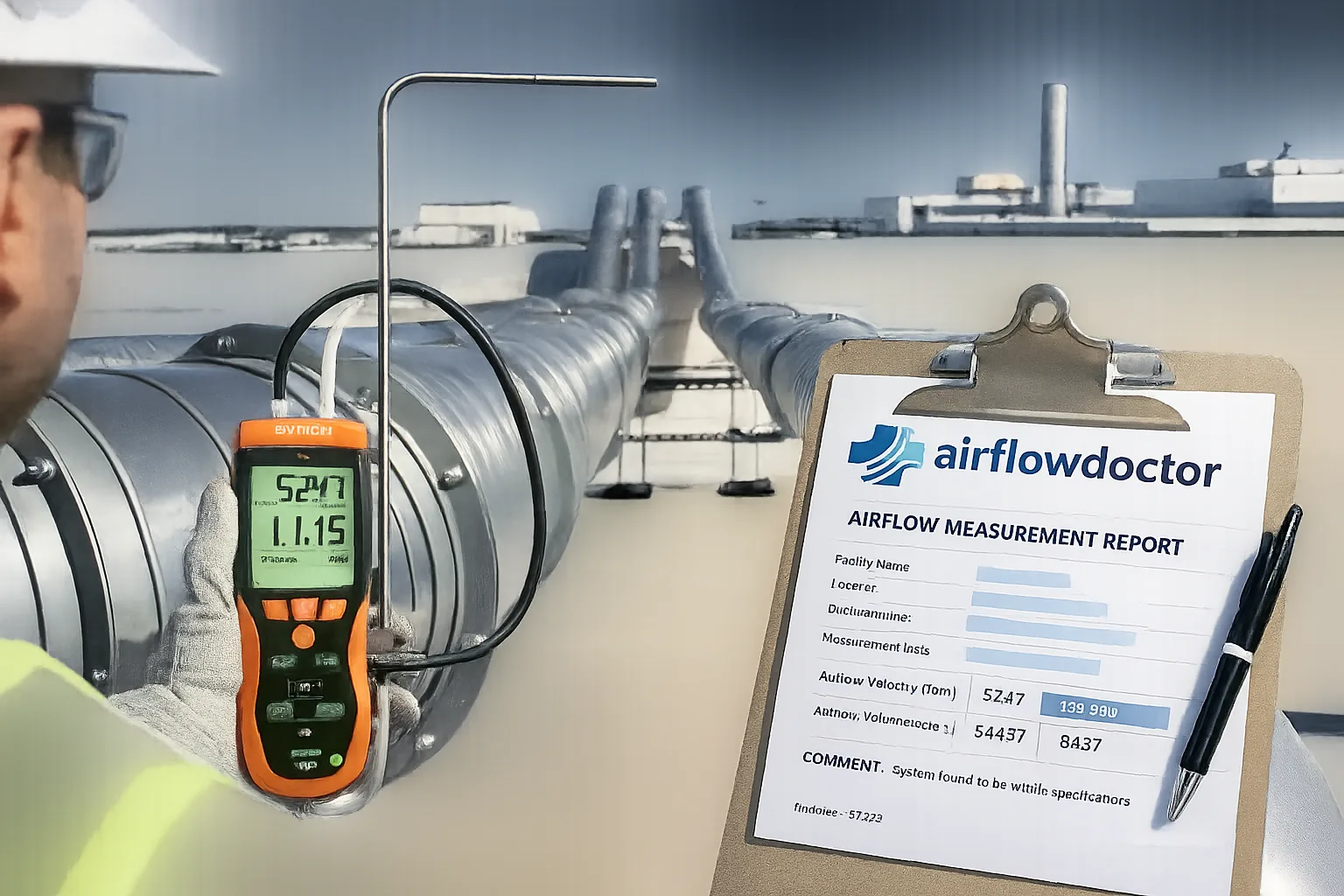
Industrial rooftop airflow measurement using a pitot tube and digital manometer

A service brand of Industrial Airflow Verification

Airflow problems checked clearly.

AirflowDoctor is the more direct, problem-focused doorway for industrial and commercial airflow checks in Southwestern Ontario: weak suction, dust collector performance, airflow balancing support, hood capture, fan checks, ventilation problems, and practical reports that show what to do next.

Want a quick airflow check? Email a few photos, symptoms, or system details and we’ll point you in the right direction. info@airflowdoctor.com
Southwestern Ontario Pitot tube CFM verification Dust collection + LEV testing Airflow balancing support Annual / bi-annual reports Photo + data reporting Vendor-neutral

AirflowDoctor is a service brand of Industrial Airflow Verification.

Services

Measurement and reporting first, with a light touch of consulting and airflow balancing support where a system is uneven or underperforming. Small focused checks are welcome, and larger verification reviews are available when the issue needs a broader look. No equipment sales. No commission.

Targeted airflow checks

Focused CFM and static pressure checks for one weak branch, hood, pickup point, fan, or dust collector connection.

Dust collection performance verification

CFM measurements, capture observations, balancing support, and bottleneck identification to document airflow conditions where they matter.

Dust collector balancing →

Airflow balancing support

Measurements to help identify uneven branches, weak pickup points, over-pulled zones, exhaust / make-up air mismatch, and systems that need practical balancing adjustments.

Airflow balancing →

Local exhaust ventilation (LEV) testing

Hood airflow and capture checks for welding fumes, grinding dust, and process exhaust.

Ventilation, make-up air + building pressure balance

Check supply vs exhaust, document negative pressure issues, ventilation imbalance, and practical next steps.

Ventilation balancing →

Fan & blower performance verification

Confirm operating point using measured airflow and static pressure—especially after complaints or retrofits.

Post-install / post-modification validation

Independent airflow verification after new ducting, new branches, collector changeouts, or equipment additions.

Troubleshooting (root cause)

When “it never worked right”—measure, isolate causes, and prioritize fixes without upsell pressure.

Targeted checks for common plant airflow problems

Not every airflow issue needs a large study. Many plants simply need an independent check of one problem point, or a practical look at whether a dust collection or exhaust system is balanced across the branches that matter.

Single branch or pickup point

For weak suction at one machine, duct branch, hood, drop, or pickup point. Best fit when the question is: “is this point actually moving enough air?”

Dust collector suction check

For plants trying to determine whether poor pickup is tied to the collector, filters, fan, ducting, dampers, or one specific branch.

Before / after verification

For maintenance changes such as filter replacement, duct cleaning, fan repair, damper changes, or branch modifications.

Uneven system balance

For systems where one branch pulls hard while another is weak, or where new equipment has changed the airflow distribution.

Larger reviews, recurring verification programs, and formal reporting are handled under the same service umbrella through Industrial Airflow Verification.

How it works

Simple process, clean documentation. We keep the report as technical as it needs to be—no more.

On-site flow

  1. Short scope call (systems, access, safety)
  2. Walkdown + measurement plan
  3. Pitot tube traverse + pressure readings
  4. Photos + point IDs so it’s repeatable

What we hand you

  • A clear summary of measured performance
  • What’s limiting the system (and why)
  • “Try first” fixes vs bigger changes
  • Optional baseline for future re-checks

Annual & bi-annual dust collection verification reports

Dust collection airflow performance drifts over time. Filters load, fans wear, ducting gets modified, and production creeps — often without obvious alarms. A simple recurring verification cadence keeps you ahead of problems and creates clear documentation.

Recommended cadence

  • Annual: higher dust load, frequent changes, or audit / EHS sensitivity
  • Bi-annual: stable systems with minimal modifications
  • Also recommended after ducting, hood, fan, or process changes

Why it’s important

  • Catch gradual airflow loss before operators feel it
  • Reduce housekeeping issues and nuisance dust
  • Document “baseline vs current” for clearer maintenance decisions
  • Verify that maintenance or upgrades actually worked

What you get each cycle

  • Repeatable point IDs + photos for consistent re-checks
  • Clear summary of measured airflow and constraints
  • Flags for meaningful drift vs prior reports (if available)
  • Prioritized fixes: “try first” vs capital projects

Common triggers for a scheduled review

  • Filter plugging / maintenance costs climbing
  • “Weak suction” complaints or visible dust escape
  • Upcoming EHS / insurer / internal reviews
  • New machines added to an existing system over time

Deliverables

Readable, specific, and practical.

Measurement summary

Results by measurement point, with assumptions and constraints stated clearly.

Findings & bottlenecks

Observed issues that explain performance, prioritized by impact.

Practical next steps

Recommendations with scope clarity (what to try first, and why).

Year-over-year comparison

For recurring programs, we can compare results against prior reports (when available) to spot drift and prioritize fixes.

Project scoping

Every airflow problem is a little different, so pricing is quoted after a short scope call. The goal is to keep the work focused: confirm what needs to be measured, identify site access constraints, and provide a clear quote before any visit is scheduled.

Targeted airflow check

Focused issue

  • One localized concern: branch, hood, pickup point, fan, or collector connection
  • CFM/static pressure readings where access allows
  • Short PDF summary with photos, results, limitations, and next steps
Best fit when the question is focused: “Is this point actually moving enough air?”

Standard site review

System or problem area

  • Scope call, drawing/photo review, and measurement plan
  • Walkdown plus selected airflow/static pressure readings
  • Concise report with findings, bottlenecks, balancing observations, and practical next steps
Suited to one dust collection system, exhaust system, production area, or recurring airflow problem.

Follow-up verification

After changes

  • Re-check key points after maintenance, cleaning, filter changes, or modifications
  • Confirm improvement vs baseline where prior readings exist
  • Short addendum report for internal records or project close-out
Useful after damper changes, duct cleaning, fan work, collector changes, or branch balancing adjustments.

Final pricing depends on travel, access, number of measurement points, safety requirements, review time, and reporting detail. Larger multi-system reviews, recurring verification programs, insurer/EHS documentation packages, or U.S. travel are quoted after scope.

Service area

Primary service area is Southwestern Ontario. Travel elsewhere in Ontario and into the United States may be available on a case-by-case basis depending on scope and schedule.

Southwestern Ontario (primary)

  • Windsor–Essex, Chatham-Kent, Sarnia-Lambton
  • London, St. Thomas, Woodstock, Ingersoll, Elgin & Oxford County
  • Kitchener-Waterloo, Cambridge, Guelph
  • Hamilton, Brantford, Niagara Region
  • GTA (as scoped): Mississauga, Brampton, Vaughan, Markham, Oakville
Not listed? Send your city—we often travel within the region.

USA travel (case-by-case)

U.S. work can make sense for repeat clients or projects near the border. We’ll confirm feasibility during the scope call.

  • Border-near manufacturing and distribution facilities
  • Multi-plant programs with repeatable reporting
  • Post-install verification for capital projects

FAQ

Quick answers about access, measurement, and reporting.

Do you sell equipment or do installs? vendor-neutral

No. We focus on independent measurement, verification, and clean documentation. Recommendations are scoped and prioritized—without sales pressure.

What methods do you use? field measurement

Established field practices: pitot tube traverses, static pressure readings, clear assumptions, and repeatable point IDs. If you have an internal spec, we can align to it.

How long does a site take? often 1–2 days

Many facilities can be measured in a day with reporting shortly after. Complex systems or large sites may take multiple days.

Can you work with our contractor or engineer? yes

Yes. We can coordinate measurement points and reporting needs while remaining independent—useful for close-out, warranty, or dispute resolution.

How often should we re-verify dust collection airflow? annual / bi-annual

Many facilities choose annual verification for higher dust loads or frequent changes, and bi-annual verification for stable systems. Re-checking is also smart after ducting, hood, fan, or process changes—airflow drift is common and usually not obvious day-to-day.

Do you keep measurement points consistent year-over-year? repeatable

When access allows, yes. We use point IDs and photos so the same locations can be re-checked and compared over time.

What is the scope of the report? practical verification

Reports are intended for practical airflow verification, troubleshooting, balancing support, and maintenance planning. They are not a substitute for certified TAB reports, engineered system design, code compliance reviews, Pre-Start Health and Safety Reviews, combustible dust hazard analysis, occupational hygiene exposure assessments, or equipment manufacturer inspections where those services are required.

Request a Quote

Tell us what you want verified and where. This can be a targeted check for one weak point, airflow balancing support for an uneven system, or a broader site review. We’ll respond with a scoped plan and a clear quote.

No spam. Your info is used only to respond to your request.

Prefer direct contact?

Email is best for attaching drawings or photos.

Email Back to top

Typical reasons people call

  • “Suction feels weak” or dust/fumes escaping
  • Filters plugging / maintenance costs climbing
  • New install—need independent validation
  • After adding equipment, existing pickups underperform or the system seems unbalanced
  • Upcoming EHS / insurer / internal review — need clear measurement documentation